 ZarJob
Discover What Really Happens Behind the Scenes After You Submit Your Job Application and Learn How Employers Decide Who Gets Invited for an Interview:
Applying for a job can be both exciting and stressful. After spending time updating your CV, writing a personalised cover letter, and carefully completing an online application, you finally click the “Apply” button with the hope that this could be the opportunity that changes your career.
Then… the waiting begins.
You check your email several times a day, answer every unknown phone call, refresh your inbox repeatedly, and perhaps even revisit the job advert to make sure you didn’t miss anything. A few days pass, then a week, and before long you begin asking yourself questions that almost every job seeker has wondered at some point.
“Has anyone actually looked at my application?”
“Did my CV get rejected?”
“Why haven’t I heard anything?”
“How long does the recruitment process usually take?”
If you’ve asked yourself these questions before, you’re certainly not alone.
One of the biggest frustrations people experience while looking for work is not knowing what happens after submitting an application. Because the recruitment process takes place behind the scenes, many applicants assume that silence means rejection. While that can sometimes be true, it often isn’t.
Recruitment is a carefully planned process involving several different stages before a hiring decision is made. Human Resources professionals, recruiters, hiring managers, department heads, and sometimes even senior executives may all be involved before interviews are arranged.
Large employers can receive hundreds—or even thousands—of applications for a single vacancy. Before anyone is invited for an interview, those applications must be organised, reviewed, compared, discussed, and narrowed down to a shortlist of the strongest candidates.
This entire process takes time.
For some companies, recruitment may take only a few days. For larger organisations, banks, government departments, or multinational businesses, it may take several weeks before candidates hear anything.
Understanding how this process works can remove much of the uncertainty that job seekers experience while waiting for feedback. More importantly, it can help you understand how recruiters evaluate applications and what you can do to improve your chances of progressing through each stage.
Whether you’re applying for your first job after school, searching for graduate opportunities, changing careers, or applying for a senior management position, the recruitment journey usually follows a similar pattern.
In this comprehensive guide, we’ll take you behind the scenes and explain exactly what happens from the moment you submit your application until a successful candidate receives a job offer.
By understanding each stage of the hiring process, you’ll know what employers are doing behind the scenes, why recruitment sometimes takes longer than expected, and how you can position yourself as a stronger candidate in future applications.
Many people believe their job is finished once they’ve submitted their application.
In reality, that’s only the beginning.
Employers don’t simply open their inbox, glance through a few CVs, and immediately invite people for interviews. Hiring the right employee requires careful planning because every recruitment decision affects the future success of the business.
Employing the wrong person can cost companies significant amounts of time, money, and productivity. For this reason, organisations invest considerable effort into finding candidates who not only possess the right qualifications but who will also fit well within the team and company culture.
Understanding how employers make these decisions provides several important advantages.
It helps you remain patient during periods of silence, improves your understanding of how recruiters think, and allows you to prepare stronger applications in the future.
It also reminds you that not receiving immediate feedback does not necessarily mean your application has been unsuccessful.
Sometimes recruiters are still reviewing applications.
Sometimes hiring managers are unavailable.
Sometimes internal approvals are delayed.
Sometimes companies decide to extend the application deadline after receiving fewer applications than expected.
There are many reasons why recruitment can take longer than anticipated, and very few of them have anything to do with the quality of your application.
From a job seeker’s perspective, the recruitment process starts when you submit your application.
From an employer’s perspective, however, the process often started weeks earlier.
Long before a vacancy appears online, managers usually identify a staffing need.
Perhaps an employee resigned.
Maybe the business is expanding.
A new department could be opening.
Sometimes an existing employee receives a promotion, creating another vacancy within the organisation.
Once approval has been obtained to recruit, Human Resources and department managers work together to prepare the job description, define the required qualifications, determine salary expectations, and decide where the vacancy should be advertised.
Only after all of these steps have been completed does the job become visible to the public.
When you submit your application, you’re entering a recruitment process that has already been carefully planned behind the scenes.
The first stage begins the moment you click “Submit.”
Depending on how you applied, your application is normally received through one of several channels.
These may include:
Most large organisations no longer manage applications manually.
Instead, applications are automatically stored inside specialised recruitment software that keeps everything organised.
If you’ve ever received an automatic email confirming that your application has been received, this is usually generated by one of these recruitment systems.
Don’t worry if you don’t receive an acknowledgement email immediately.
Not every employer sends automatic confirmations.
The important thing is ensuring your application was submitted successfully before closing your browser.
Once your application has been received, it joins every other application submitted for that particular vacancy.
This is where many applicants incorrectly assume recruiters immediately begin reading CVs.
In reality, most employers wait until one of the following happens:
During this period, applications are safely stored within the employer’s recruitment database.
Large organisations may receive hundreds of applications every day.
Some graduate programmes attract several thousand applicants.
Imagine trying to review thousands of CVs one by one without any system to organise them.
It would be almost impossible.
This is why modern recruitment software has become such an important part of today’s hiring process.
One of the biggest misconceptions about recruitment is that Human Resources staff immediately begin reading every application as soon as it arrives.
In reality, recruitment software first helps organise all incoming applications.
These systems don’t automatically hire people.
Instead, they help recruiters manage large volumes of information efficiently.
Applications are grouped together, candidate details are stored securely, documents are organised, and recruiters are provided with tools that make reviewing applications much faster.
This allows hiring teams to spend more time evaluating suitable candidates rather than sorting through paperwork.
Understanding this stage is important because it explains why recruitment rarely happens overnight.
Even before a recruiter opens your CV, considerable administrative work has already taken place behind the scenes.
Once applications begin moving through the recruitment process, Human Resources professionals or recruiters usually conduct the first manual review.
At this stage, they aren’t necessarily searching for the “perfect” candidate.
Instead, they’re trying to identify applicants who meet the minimum requirements needed to progress further.
Typical questions include:
Recruiters also pay attention to presentation.
A clear, well-structured CV that’s easy to read often creates a much stronger first impression than one that’s cluttered or difficult to follow.
Contrary to popular belief, recruiters don’t spend ten or fifteen minutes reading every CV during the first review.
When hundreds of applications have been received, initial reviews are often completed surprisingly quickly.
That’s why making important information easy to find is so important.
After reviewing applications that meet the basic requirements, recruiters begin creating a shortlist.
This shortlist usually contains the candidates who most closely match the position based on their qualifications, experience, skills, and overall suitability.
Creating a shortlist isn’t always straightforward.
Recruiters often compare candidates with very similar backgrounds.
Sometimes several applicants meet every requirement.
In these situations, small details can make a big difference.
Additional certifications, stronger achievements, better-presented CVs, relevant volunteer work, or more recent industry experience may influence who progresses to the interview stage.
It’s also important to understand that recruitment decisions aren’t based solely on technical ability.
Hiring managers are also considering whether candidates are likely to fit into the company’s culture, work well within existing teams, and demonstrate the professionalism needed for long-term success.
For this reason, your CV tells only part of your story.
The way you present yourself, communicate professionally, and prepare for each stage of recruitment can become just as important as your qualifications.
In the next part of this guide, we’ll explore what happens after you’ve made the shortlist, including:
By the end of Part 2, you’ll have an insider’s understanding of the recruitment process and know exactly what employers are looking for as they move closer to selecting the right candidate.
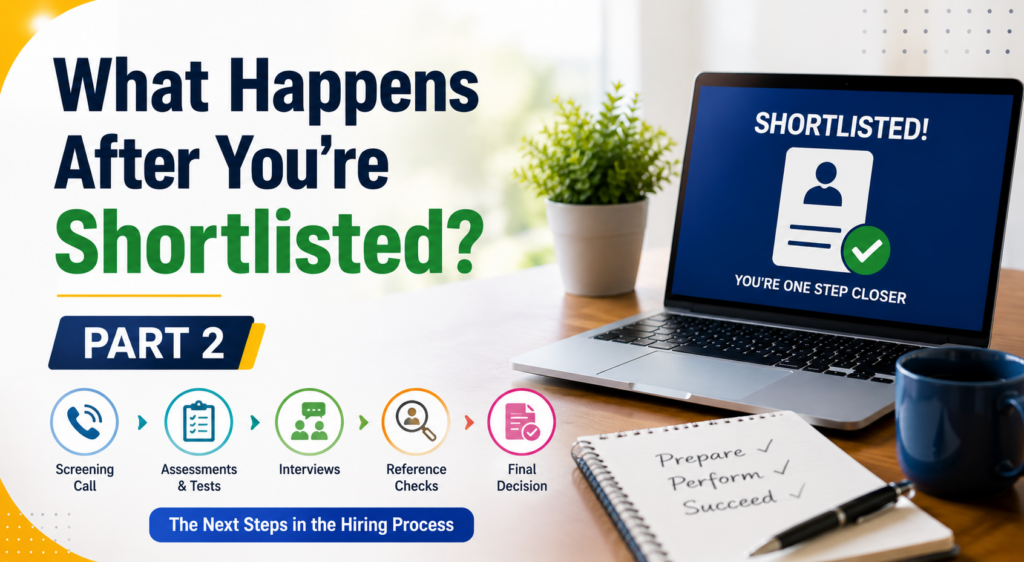
Making it onto a recruiter’s shortlist is a significant achievement, especially if the employer received hundreds of applications. It means your qualifications, experience, and overall profile stood out enough for the recruitment team to take a closer look.
However, being shortlisted doesn’t automatically guarantee an interview or a job offer.
This stage is where employers begin gathering more detailed information about candidates to determine who is best suited for the position. They want to move beyond what’s written on your CV and understand how you communicate, solve problems, work with others, and whether you’re likely to succeed within their organisation.
The steps that follow may vary depending on the company, industry, and seniority of the role, but most employers follow a structured process before making a final hiring decision.
Let’s take a closer look at what usually happens next.
Before inviting candidates for a formal interview, many employers conduct a short telephone or virtual screening.
This conversation usually lasts between 10 and 30 minutes and serves as an opportunity for recruiters to confirm important information while learning a little more about the candidate.
Although it may seem informal, this conversation plays an important role in the recruitment process.
Recruiters may ask questions such as:
This initial discussion also allows recruiters to assess your communication skills, professionalism, confidence, and enthusiasm.
Remember, this is often your first direct interaction with the employer, so making a positive impression is important.
For many positions, especially technical or specialised roles, employers may ask shortlisted candidates to complete assessments before scheduling interviews.
These assessments help determine whether applicants possess the practical knowledge required for the position.
Examples include:
These assessments aren’t designed to trick candidates. Instead, they help employers compare applicants using consistent standards.
Preparing beforehand by practising similar assessments online can improve your confidence and performance.
Some organisations also use personality questionnaires as part of their recruitment process.
These assessments don’t usually have right or wrong answers.
Instead, they help employers understand how candidates naturally approach different workplace situations.
For example, they may evaluate:
The goal isn’t to eliminate candidates simply because of their personality.
Rather, employers want to understand how someone may fit within existing teams or specific job requirements.
The best approach is always to answer honestly rather than trying to guess what the employer wants to hear.
For many candidates, this is the most anticipated part of the recruitment journey.
Interviews give employers the opportunity to move beyond qualifications and experience while getting to know candidates as individuals.
Depending on the organisation, you may attend:
During the interview, employers often explore topics such as:
Interviewers also observe:
Many employers use behavioural interview questions because past behaviour often provides insight into future performance.
Examples include:
Using real examples from your own experience often creates stronger interview answers.
Once interviews have been completed, employers often contact the references listed on your CV.
References help employers verify information while learning more about your previous work performance.
Typical questions include:
This is why it’s important to ask someone’s permission before listing them as a reference.
Always ensure your references have current contact details and know they may be contacted.
Many employers also conduct background checks before making a final offer.
These checks vary depending on the position.
They may include:
These checks help employers confirm that the information provided during the recruitment process is accurate.
Providing truthful information throughout your application is always the best approach.
Once interviews, assessments, and verification checks have been completed, hiring managers compare the final candidates.
This stage often involves discussions between Human Resources and the department manager.
Employers consider many factors, including:
Sometimes several candidates perform exceptionally well, making the final decision extremely difficult.
In these situations, small differences may determine who ultimately receives the offer.
Congratulations—you’ve successfully completed the recruitment process.
If you’re the selected candidate, the employer will usually contact you by telephone or email with a formal offer of employment.
The offer may include:
Take time to read the offer carefully before accepting.
If anything is unclear, ask questions before signing your employment contract.
One of the biggest frustrations job seekers experience is waiting.
There are many reasons why recruitment may take several weeks, including:
Silence doesn’t always mean rejection.
Many recruitment processes simply take longer than candidates expect.
Even strong applicants may be unsuccessful for reasons unrelated to their ability.
Some common reasons include:
Every application is an opportunity to learn and improve.
In the final part of this guide, we’ll cover:
By the end of the guide, you’ll have a complete understanding of the hiring journey—from clicking “Apply” to accepting a job offer—and be better prepared for every stage of your next application.
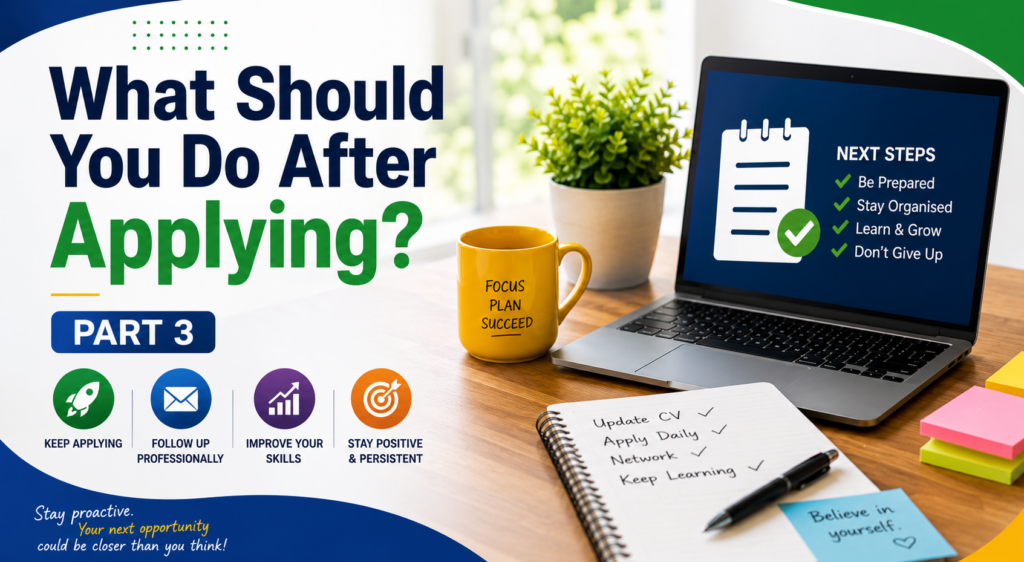
Submitting your application and completing an interview can feel like crossing the finish line, but in reality, your job search shouldn’t stop there.
One of the biggest mistakes job seekers make is putting all their hopes into a single application. While it’s perfectly natural to feel excited about a role, experienced recruiters often encourage candidates to continue applying for other opportunities until they have signed an employment contract.
Recruitment timelines vary from one employer to another, and many factors can influence how quickly decisions are made. Some companies fill vacancies within a week, while others may take a month or longer.
The period between submitting your application and receiving feedback can be frustrating, but it’s also an opportunity to remain proactive and continue strengthening your career prospects.
In this final section, we’ll explore what you should do while waiting for feedback, when it’s appropriate to follow up with an employer, how to deal with rejection professionally, and practical strategies that can improve your chances of success in future applications.
One of the most important pieces of advice any career expert can give is simple:
Never stop applying until you have officially accepted a job offer.
Many candidates make the mistake of becoming emotionally invested in one opportunity.
Perhaps the interview went well.
Maybe the recruiter seemed enthusiastic.
Sometimes applicants assume they have secured the position before receiving formal confirmation.
Unfortunately, recruitment doesn’t always work that way.
Companies may still be interviewing other candidates, waiting for internal approvals, or considering unexpected changes within the business.
Even excellent candidates are sometimes unsuccessful because another applicant had slightly more experience or better matched the company’s needs.
The smartest strategy is to continue searching and applying until you have signed your employment contract.
This approach keeps your options open while reducing disappointment if one opportunity doesn’t work out.
This is one of the most frequently asked questions among job seekers.
The answer is yes—but timing matters.
Following up professionally shows interest in the position without appearing impatient.
A good guideline is:
When following up:
Professionalism is always remembered.
Unfortunately, not every employer contacts unsuccessful applicants.
While many organisations try to provide updates, large recruitment campaigns often make this difficult due to the number of applications received.
If you don’t hear back after several weeks, it usually means one of three things:
Although this can be disappointing, don’t let it discourage you.
Instead, continue applying for other suitable opportunities while improving your CV and interview skills.
Remember, every application increases your experience and confidence.
Although every employer follows a different process, there are often positive signs that your application is moving forward.
These may include:
Each stage generally indicates that you’ve successfully progressed beyond the previous step.
Rejection is something every professional experiences at some point in their career.
Even highly experienced executives, managers, and specialists have been unsuccessful during recruitment processes.
Rather than viewing rejection as failure, consider it an opportunity to learn and improve.
If possible:
One unsuccessful application does not define your abilities or your future.
Sometimes recruitment decisions simply come down to timing or organisational needs.
After speaking to recruiters and career professionals, certain habits consistently appear among candidates who successfully secure employment.
Successful job seekers often:
Rather than sending the same CV everywhere, they customise each application to match the specific vacancy.
They understand the employer’s business, values, products, and services before attending interviews.
They practise common interview questions, prepare examples from previous experience, and arrive well prepared.
They complete online courses, improve digital skills, and stay informed about developments within their industry.
Many successful applicants keep a spreadsheet or notebook containing:
Organisation helps prevent missed opportunities.
It’s important to remember that many vacancies attract hundreds of applications.
Being unsuccessful doesn’t necessarily mean you weren’t qualified.
Sometimes another candidate simply had:
Focus on continuous improvement rather than comparing yourself to others.
Every application teaches you something valuable.
Even after receiving an offer, there may still be additional steps before your first day of work.
These can include:
Once these steps have been completed, you’ll officially begin your new role.
It depends on the employer. Some positions are filled within a week, while larger organisations may take several weeks or even months.
No. Recruitment delays are common, and employers may still be reviewing applications or scheduling interviews.
Yes. Continue applying until you’ve accepted a formal job offer.
Yes. A polite follow-up after a reasonable waiting period is acceptable.
Multiple interviews help employers evaluate technical skills, cultural fit, communication, and long-term suitability.
Many employers conduct reference checks after interviews and before finalising their hiring decision.
Depending on the employer, you may not progress to the next stage. However, each assessment provides valuable experience for future opportunities.
Yes. Budget approvals, management availability, and internal processes can all delay recruitment.
Tailor your CV, prepare thoroughly for interviews, continue learning, and seek feedback whenever possible.
Not at all. Recruitment decisions depend on many factors, and even excellent candidates experience rejection. Persistence and continuous improvement are key.
The recruitment process is much more complex than simply submitting a CV and waiting for a phone call. Behind every vacancy is a carefully managed process involving planning, screening, assessments, interviews, reference checks, and final decision-making.
Understanding how this journey works gives you an important advantage. Instead of feeling uncertain during periods of silence, you’ll have a clearer picture of what’s happening behind the scenes and why each stage takes time.
Most importantly, remember that finding the right job is often a journey rather than a single event. Every application helps you gain experience, improve your confidence, and refine your approach. Stay patient, continue developing your skills, tailor your applications, and remain open to new opportunities.
Your next application could be the one that opens the door to the career you’ve been working towards. Stay positive, stay prepared, and keep moving forward—because persistence is one of the most valuable qualities any employer can find.







 📢 Get Job Alerts on WhatsApp
 Home
Home View all Posts
 Post a Job